Which Types of Manufacturing Projects Can Apply for BOI Investment Promotion?
Emory
Views: 96
2026-10-08 11:45:10
Comments: 0
About TMA Group
TMA Group is a professional company focusing on local recruitment and corporate consulting in Thailand, dedicated to providing one-stop services including recruitment, financial management, tax disposal, legal consulting, personnel management, etc. for enterprises and individuals. If you need more advice on investment in Thailand, please feel free to contact us.
—— TMA GROUP ——
Many companies planning to invest in and establish a factory in Thailand have the same question:
“Since we are already a manufacturing company, does that mean we can apply for BOI promotion as long as we build a factory in Thailand?”
The answer is: not every manufacturing project is eligible.
Having a factory, purchasing machinery, or engaging in manufacturing activities does not automatically mean that a project will qualify for BOI investment promotion.
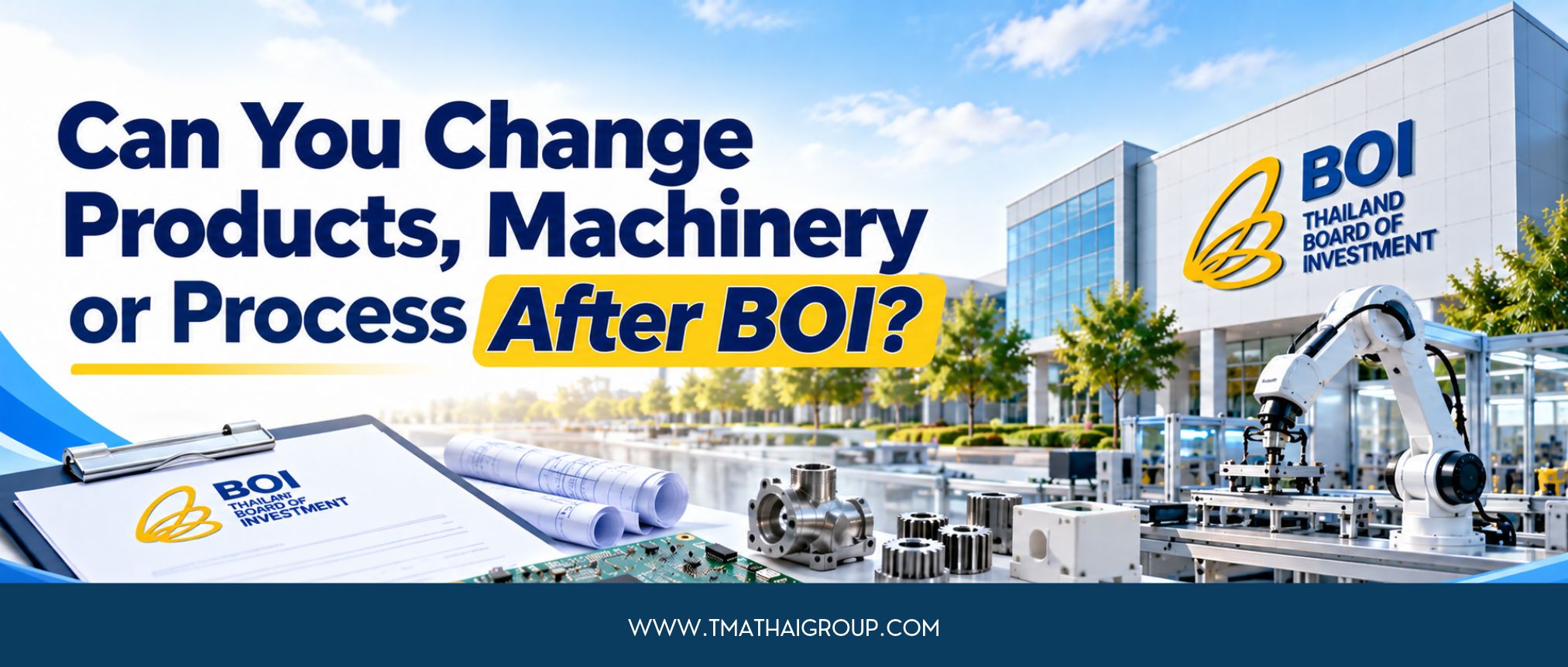
Whether a manufacturing project can apply for BOI promotion first depends on whether it falls within an Activity currently promoted by the Thailand Board of Investment (BOI). The project must also satisfy the specific conditions applicable to that Activity.
Therefore, before making a final investment decision or submitting a BOI application, companies planning to establish a manufacturing facility in Thailand should review the following five key areas.
Product: What Will You Manufacture?
The first step is to confirm the actual product to be manufactured, including its specifications, characteristics, and intended use.
When determining the applicable BOI project category, BOI does not simply look at the business scope stated in the company registration documents. Instead, it evaluates the actual investment project and determines which Activity in the BOI promotion list the product falls under.
For example, a single industry may contain several different Activities. Differences in product specifications, functions, applications, or even manufacturing methods may affect the final project classification and the incentives available.
Therefore, the first key question is:
“Which BOI Activity does my product actually fall under?”
Production Process: How Will It Be Manufactured?
Once the product has been matched with a potential Activity, the next step is to review the company’s Process Flow.
Some BOI Activities impose specific requirements on the manufacturing process, such as:
Whether certain key production steps are included
Whether the required technical criteria are met
Whether the project creates a sufficient level of value added
Therefore, even if two companies manufacture similar products, BOI eligibility may differ if one company operates a complete core manufacturing process while the other only performs simple assembly, packaging, or partial processing.
For manufacturing projects, it is important to consider not only “what is produced,” but also “how it is produced.”
Main Machinery: What Equipment Will Be Used?
The third area to review is the project’s Main Machinery.
Companies should assess whether the following factors are consistent with the project scale and production process:
Machinery type
Equipment specifications
Quantity
Intended use
Production capacity
Particular attention should be paid to the relationship between the machinery and the Process Flow.
Each major production step declared in the BOI application should be supported by appropriate machinery. At the same time, the proposed production capacity should be reasonably calculated based on machinery specifications, quantity, working hours, and other relevant data.
Therefore, the Machine List is not simply a list of equipment the company plans to purchase. It is an important part of the overall BOI project structure.
Investment Amount: Does the Project Meet the Required Threshold?
The fourth key factor is the project investment amount.
Companies should confirm two issues in advance:
First, does the project meet the minimum investment requirement applicable to the relevant Activity?
Second, which planned expenditures can be counted as eligible project investment under BOI rules?
Machinery, factory construction, and other project-related investments must be assessed according to BOI criteria. Not every expense incurred for the project can automatically be counted toward the BOI-recognized investment amount.
For companies planning to apply for BOI promotion, it is therefore advisable to review BOI requirements during the project planning stage rather than waiting until the entire investment budget has already been finalized.
Specific Project Conditions: Are There Any Additional Requirements?
Finally, companies should review whether the relevant Activity or the project itself is subject to any additional conditions.
These may include:
Project location
Product or industry standards
Environmental requirements
Manufacturing licenses
Other permits required by government authorities
Regulatory requirements can vary significantly depending on the industry and product.
Manufacturing projects involving food, medical devices, electrical and electronic products, automotive parts, chemicals, and other regulated sectors may require approvals or compliance with industry standards from authorities other than BOI.
Therefore, “meeting BOI requirements” and “obtaining all licenses required for actual business operations” are two separate issues that must both be considered.
Do Not Choose an Activity Based Only on Its Name
This is a common mistake during the early stages of BOI planning.
A company may see an Activity in the BOI list that appears similar to its business and immediately use that category to structure the investment or prepare the application.
However, BOI project classification should be based on a combined assessment of:
Product
Process
Machinery
Capacity
Investment
Specific Conditions
If the selected Activity does not match the actual project, the application may need to be revised later, and the mismatch may also affect the investment incentives the company expects to receive.
For companies planning to establish a manufacturing base in Thailand, it is advisable to prepare the following information before purchasing large amounts of machinery, finalizing the production plan, or submitting a BOI application:
Product Spec | Product specifications and intended use
Process Flow | Complete manufacturing process
Machine List | Main machinery and equipment list
Investment Plan | Preliminary investment plan
These materials can be used to conduct Activity Mapping, helping to determine:
Which BOI Activity the project may fall under
Whether the project meets the applicable eligibility requirements
Whether the current investment or production plan needs to be adjusted
BOI promotion is not simply a matter of “having a factory.” Whether a manufacturing project qualifies depends on the combination of product, production process, machinery, investment scale, and project-specific conditions.
If you are unsure whether your manufacturing project falls within the scope of BOI investment promotion, you may provide the relevant project information to TMA GROUP. We can assist with Activity Mapping, preliminary eligibility assessment, and the planning of the subsequent BOI application based on the actual project.

Disclaimer
TMA Consulting Management has been paying attention to the updating of information through newsletters for many years, but we do not assume any responsibility for the completeness, correctness or quality of the information provided. No information contained in this article can replace the personal consultation provided by a qualified lawyer. Therefore, we do not assume any liability for damages caused by the use or non-use of any information in this article (including any kind of incomplete or incorrect information that may exist), unless it is caused intentionally or by gross negligence.