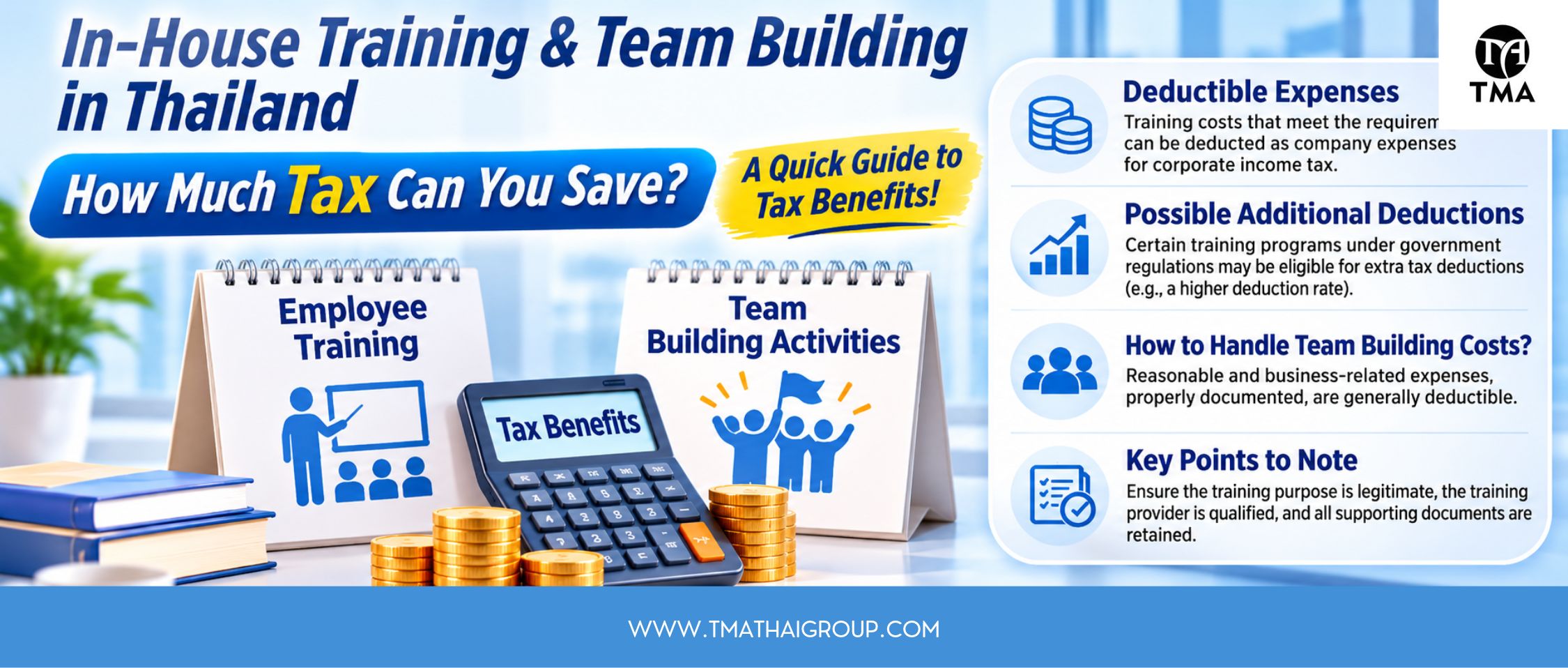
In general, employee training expenses incurred for business purposes may be treated as tax-deductible business expenses for Corporate Income Tax (CIT) purposes, provided that they comply with the requirements of the Revenue Code and are wholly and exclusively incurred for the company's business operations.
Examples include:
Professional skills training
Job qualification or certification training
Occupational health and safety training
Management and leadership training
New employee orientation and onboarding programs
To support the tax deduction, companies should retain appropriate documentation, including:
Training agreements or contracts
Invoices or Tax Invoices
Training materials and course outlines
Employee attendance records
Proof of payment
These documents help demonstrate that the expenses are directly related to the company's business activities.
As a general rule, employee training expenses that are business-related, actually incurred, and supported by proper documentation may be deducted for corporate income tax purposes under the Revenue Code.
In certain cases, however, qualifying training expenses may also be eligible for an enhanced tax deduction exceeding 100%, provided that the applicable government requirements are satisfied.
Generally, the following conditions should be met:
1. The Training Must Be Provided to Employees
The training should be intended to improve employees' professional skills, work performance, or career development. It should not primarily benefit shareholders, directors in their personal capacity, or individuals unrelated to the company's business operations.
2. The Training Should Support Government-Promoted Objectives
Eligible training programs may include:
Skill development programs
Technical skills training
Digital skills development
Training related to automation, artificial intelligence (AI), robotics, and industrial transformation
Programs that enhance productivity, operational efficiency, or workplace safety
The actual scope of eligible training is subject to the incentive programs announced by the Thai government.
3. The Training Provider Must Meet the Applicable Requirements
Certain tax incentive schemes require the training to be conducted by qualified or government-recognized institutions, such as:
Programs accredited by the Department of Skill Development (DSD)
Universities and higher education institutions
Government training agencies
Other organizations recognized under the applicable regulations
The eligibility requirements may vary depending on the specific incentive program.
4. Required Procedures and Supporting Documents Must Be Completed
Companies should maintain sufficient supporting documentation, including:
Some incentive programs may also require prior approval, registration, or notification to the relevant government authority before the enhanced tax deduction can be claimed.
Many companies organize activities such as:
Whether these expenses are tax-deductible depends on the nature and purpose of the activity.
If the primary purpose of the event is to promote employee welfare, team development, or business management, and the expenses satisfy the requirements of the Revenue Code, they may generally be treated as deductible business expenses for corporate income tax purposes.
However, expenses relating to personal consumption that are unrelated to the company's business, or expenses that cannot be adequately supported by documentation, may not be fully deductible.
Therefore, companies should retain appropriate supporting documents, including:
These documents help substantiate the tax treatment of the expenses.